Information, against the brief
Compare the title, date, venue, and contact instructions with the approved source.
For teams that approve event posters on deadline. Rayd uses Claude to read the design and its approved brief side by side, then points reviewers to the wrong date, the missing line, or the unreadable text before it goes to print.
13:00 — 17:00
STUDIO 04
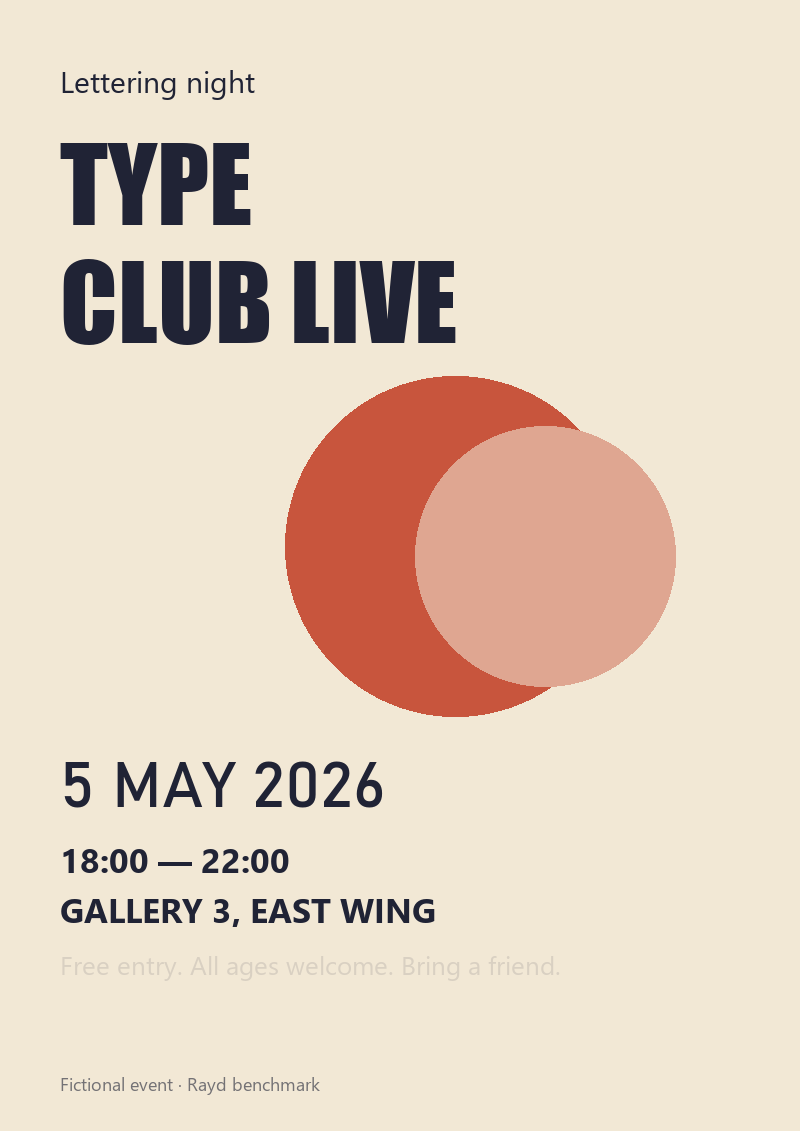
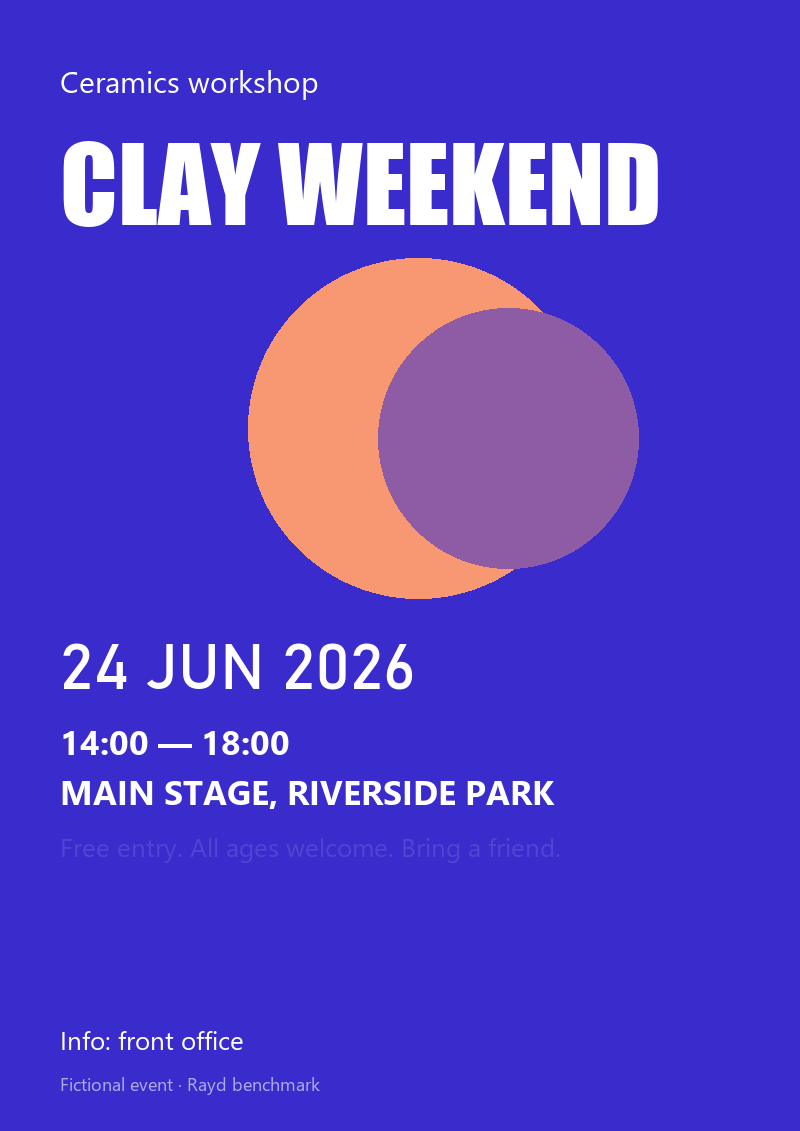
24 Oct on the poster. 25 Oct in the brief.
A poster can look ready while one critical detail is still wrong. Rayd brings the source, the design, and the reviewer into one review.
Compare the title, date, venue, and contact instructions with the approved source.
Surface readability, placement, and missing elements for a person to inspect.
Keep each concern connected to a poster region and a source requirement. People make the final decision.
Wherever one brief turns into many posters, banners, and social cards, the same checks are repeated by hand, often by the person with the least time left before print.
Several client briefs at once, each with its own dates, venues, and approval chain.
Student councils and clubs publishing frequent events with rotating volunteer designers.
Program schedules that change late, and posters that must change with them.
Notices where a wrong date or missing contact line reaches thousands of residents.
Select a concern to highlight its location and compare the evidence. Switch to the revised poster to see the corresponding example edit.
The outlined area is the selected evidence region. You can also select a region directly.
View the selected findingUse the approved details below on the final poster.
Synthetic brief. All names, locations, and event details are fictional.
Local demo state only. This does not approve the poster.
Return to the posterEach sample finding carries a category, source requirement, observed content, and normalized poster region. A review flag records only your choices in this browser session.
The intended MCP-based workflow connects inputs, model-assisted checks, and evidence. It keeps final approval with the team reviewing the work.
Bring the design and its source requirements together.
Claude reads both inputs and checks information and visual concerns.
Return structured observations tied to the source and poster region.
Inspect the evidence, resolve concerns, and decide what is ready.
Poster review is a multimodal comparison: an image on one side, a written brief on the other, and a structured answer people can act on. Each step maps to a Claude capability.
Extract dates, venues, and small print directly from the artwork, and judge readability in context.
Load the approved brief, including PDFs and revision notes, as the source of truth for every check.
Each finding follows the JSON schema shown in the demo: category, source field, observed text, poster region.
Connect to the storage and design tools teams already use, so review happens without re-uploading.
We built a benchmark of synthetic posters with seeded errors and clean controls, then ask Claude to review each poster against its brief. The set, the prompt, and the scoring script are part of the project.
Title typos · wrong dates · wrong times · incomplete venues · missing contact lines · low-contrast text
Claude results for this set will be published here after the first full run.
Rayd is built by a solo founder covering product and engineering, focused on one workflow: getting event posters approved without avoidable errors.
The review experience, evidence linking, and finding schema are designed and testable on this page.
Each poster and brief goes to the Claude API (vision + structured output); findings are scored against the known errors.
Bring the same pipeline into the product with poster uploads, then pilot with event and design teams.
The interactive demo uses prewritten findings for one fictional event, so the review experience can be tried without uploads. Claude's actual output is measured in the benchmark section.
Not in this version, which uses only synthetic samples. Uploads arrive with live review, the next milestone.
No. Rayd surfaces evidence; a person makes the final decision. It does not make legal infringement determinations.